
Date of Marriage and Missing Statements
Why the date of marriage matters when a retirement account existed before marriage, and what to do when older statements are reported as unavailable.
Free tool: the Records Discovery Intake Form walks counsel through exactly what to gather when statements are missing.
Request it free →When a retirement account existed before marriage, the date of marriage is often the starting point for separating marital and non-marital value.
In one case, $373,000 in non-marital retirement funds was recovered, from records the plan first reported as unavailable. A missing statement does not always mean the marital and non-marital split cannot be established.
In older marriages, the records closest to the date of marriage are often the hardest to obtain. The recordkeeper may say statements only go back seven years. That does not always mean the account history is gone. It may mean the first request was too narrow, sent to the wrong place, or asked for the wrong form of information.
This is where TOVA's Records Discovery service comes in.
Attorneys often start by asking for statements. When the answer comes back "unavailable," many assume the analysis is over. TOVA looks deeper at the plan, account history, recordkeeper history, and what has already been requested so counsel can decide the next step.
Why the date of marriage matters
The date of marriage is often the starting point when an account existed before the marriage.
The balance on or near that date helps separate what existed before marriage from what happened during the marriage. But the date-of-marriage balance is only part of the issue. The account may also have contributions, rollovers, withdrawals, loans, transfers, gains, losses, or post-cutoff activity that affects the marital value.
That is why asking for one old statement is not always enough. The retirement history has to be understood well enough to support a tracing or valuation analysis.
What "statements only go back seven years" really means
Recordkeeper portals often show only the most recent several years of formatted PDF statements. That is a portal limitation. It is not always proof that older account information no longer exists.
The move that often gets past it is to ask for data, not statements. The PDF statements on the portal are the seven-year window. The plan's underlying transaction history, in native electronic form, frequently runs back much further. A request for the data behind the statements is a different request than a stack of PDFs.
Sometimes records truly are gone. Sometimes they exist in a different form. Sometimes they are held by a prior recordkeeper, employer, payroll system, plan archive, or another related source. When a plan changed providers, a conversion file usually bridges the old system to the new one.
A documented result
We tested it. Here is what came back.
This is not theory. Here is a real case, redacted.
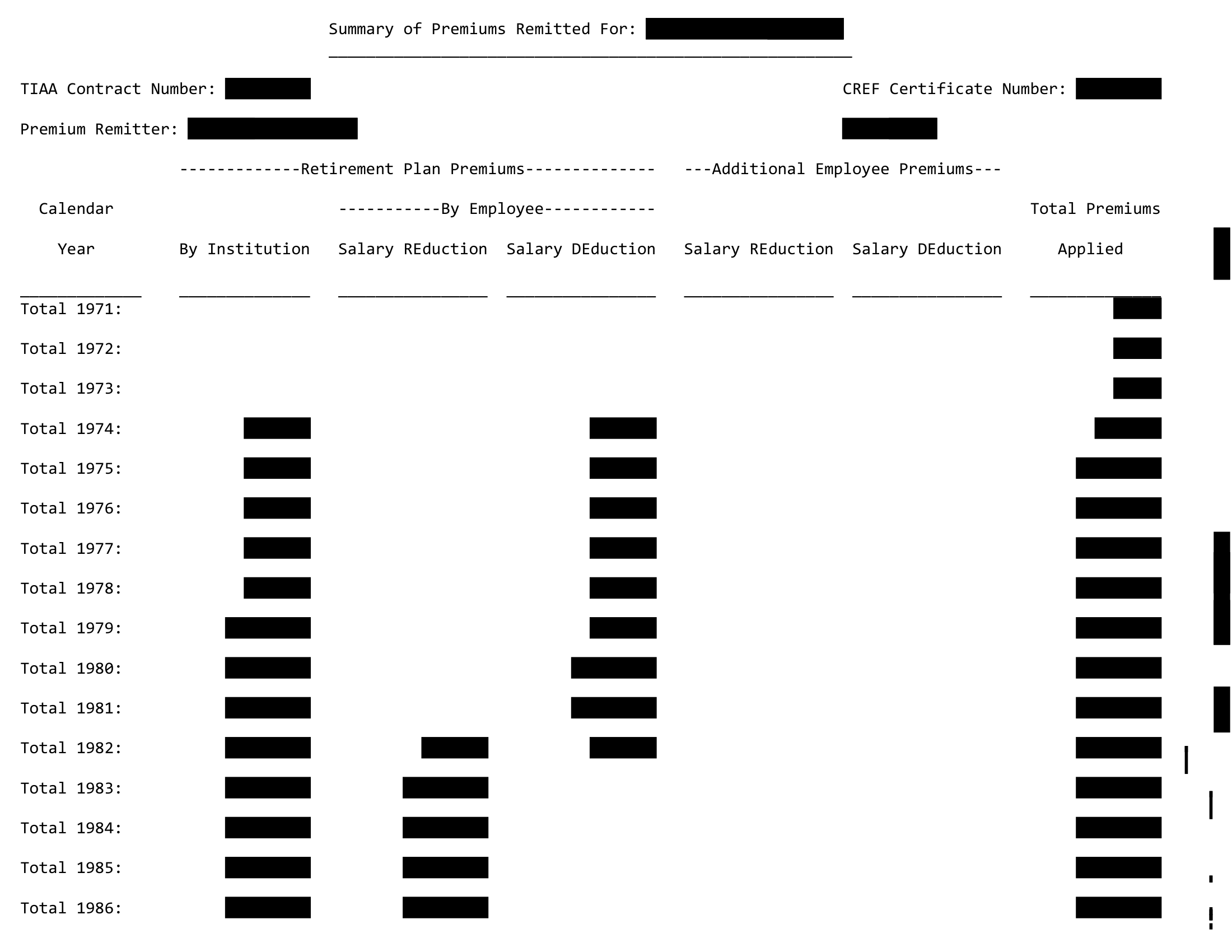
A participant had retirement accounts opened in the early 1970s and a marriage of about 21 years. He had spent months trying to get the old records and kept getting the same answer: nothing before seven years. His attorney was ready to subpoena several institutions going back two decades.
We did not subpoena anyone. We mapped the accounts, asked the participant a few targeted questions, and drafted one precise records request for him to send in his own name, with counsel copied. Sixteen days later the recordkeeper produced the account value as of the date of marriage, the value as of the date of commencement, and the full contribution history back to inception.
How it went
- Day 1. Mapped the account. Which company held the plan at the date of marriage, who holds it now, and where the gap was.
- Day 2. Asked the participant four questions: original hire date, any prior plan names, any rollovers, and the account number on his oldest paperwork.
- Day 4. Drafted a precise records request for the participant to send in his own name, attorney copied. It asked for three things by name: the balance as of the date of marriage, the balance as of the date of commencement, and the contribution history from inception.
- Day 5. He mailed it, certified.
- Day 19. The recordkeeper produced all three.
"We chased these old records for months and kept hitting the same wall: seven years and nothing before it. TOVA knew exactly what to ask for and exactly where to send it. The date-of-marriage balance and full contribution history came back fast. It saved my client a subpoena fight we were dreading." Representative attorney comment
Missing statements do not automatically end the analysis
A missing statement does not automatically mean the marital value cannot be determined.
Whether the analysis can be supported depends on the account, the plan history, the available records, and the quality of the information that can still be obtained.
This is not a promise that every missing record can be found. It is a practical point: a portal response is not the same thing as a complete records analysis.
How TOVA fits in
TOVA provides Records Discovery support when older retirement records are missing, incomplete, or reported as unavailable.
We start by reviewing what counsel already has and what has already been requested. That includes the plan name, employer, key dates, available statements, prior responses, recordkeeper history, rollovers, and any known plan changes.
From there, TOVA prepares a written records discovery plan that identifies what records may matter, where they may be held, and what counsel may want to request next.
Counsel controls legal strategy and formal discovery. TOVA provides the retirement plan and account-level analysis needed to make the record request more targeted.
What TOVA does not do
- We do not guarantee that older records exist or can be obtained.
- We do not decide what either party is legally entitled to receive.
What counsel can send to start
- The plan or account name.
- The employer, if it is an employer-sponsored plan.
- The date of marriage.
- The cutoff date, if applicable.
- Statements already available.
- What has already been requested.
- Who was asked.
- The response received.
- Any known rollover, transfer, plan change, or recordkeeper change.
A divorcing individual should work through counsel. The attorney directs discovery and legal strategy. TOVA supports the retirement records analysis.
Attorneys learn the full records-recovery process, including the provider-specific subpoena templates, at TOVA's Records Discovery Masterclass. The templates are taught and shared with trained firms, not posted for public download.
For related context, see the forensic tracing guide, the hidden retirement assets guide, the Records Discovery Masterclass, and the services and pricing page.
Older retirement statements missing?
Start with the free Records Discovery Intake Form. It captures the plan name, date of marriage, cutoff date, available statements, and prior requests, so TOVA can review the records issue and identify what may be needed to support forensic tracing or a pension present value estimate.
Request the Records Discovery Intake FormReady to start a case? Start a case or email sedelman@tovaretirement.com
By Denisa Tova-Liebman, MBA, CFP, CDFA, CQS