
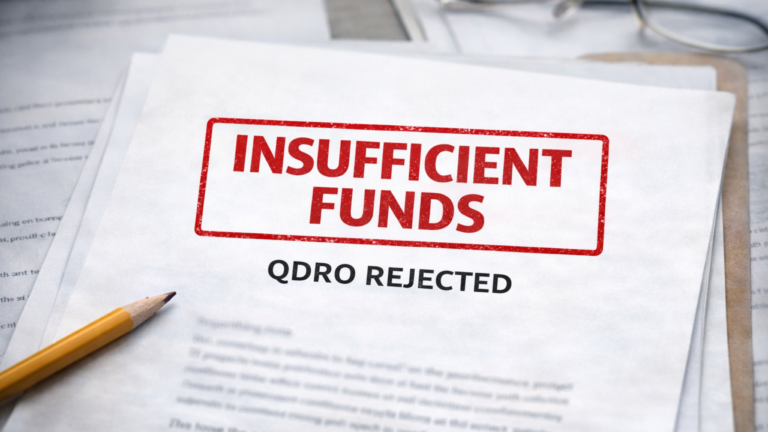
I’m seeing rejected QDROs for “insufficient funds” every week now.
And it’s colliding with another shift at the same time.
Many plans are no longer calculating gains and losses for you.
So this is no longer just about updating for investment performance. We’re reconstructing what the marital amount would have been before the market moved, money came out, loans were taken, or investments were reallocated.
Because between settlement and QDRO processing, things happen.
The market moves. The participant reallocates. Distributions occur. Loans get taken.
By the time the QDRO is submitted, the award does not apply cleanly anymore, especially when the agreement never tied the marital share to an actual number.
That’s when it gets ugly.
Who absorbs the loss? Was the alternate payee supposed to be insulated from pre-transfer activity? Did the agreement allocate market risk clearly?
This is the malpractice zone I keep getting pulled into after the fact.
TIAA comes up a lot. IRAs too.
The message is essentially this: Hand us the marital number.
If the balance is lower when the order hits their desk, they are not recalculating it for you.
They are rejecting it.
Now you have two problems.
- Someone has to calculate the actual marital number.
- On long-term marriages, you cannot do that if you let the plan shut you down with “we only keep seven years of statements.”
That is paper retention policy, not data availability.
Old statements alone will not get you there.
Transaction history and recordkeeper data will.
This is showing up more frequently than most people expect right now. If you are drafting settlement language that does not produce an executable number, you are exposed.